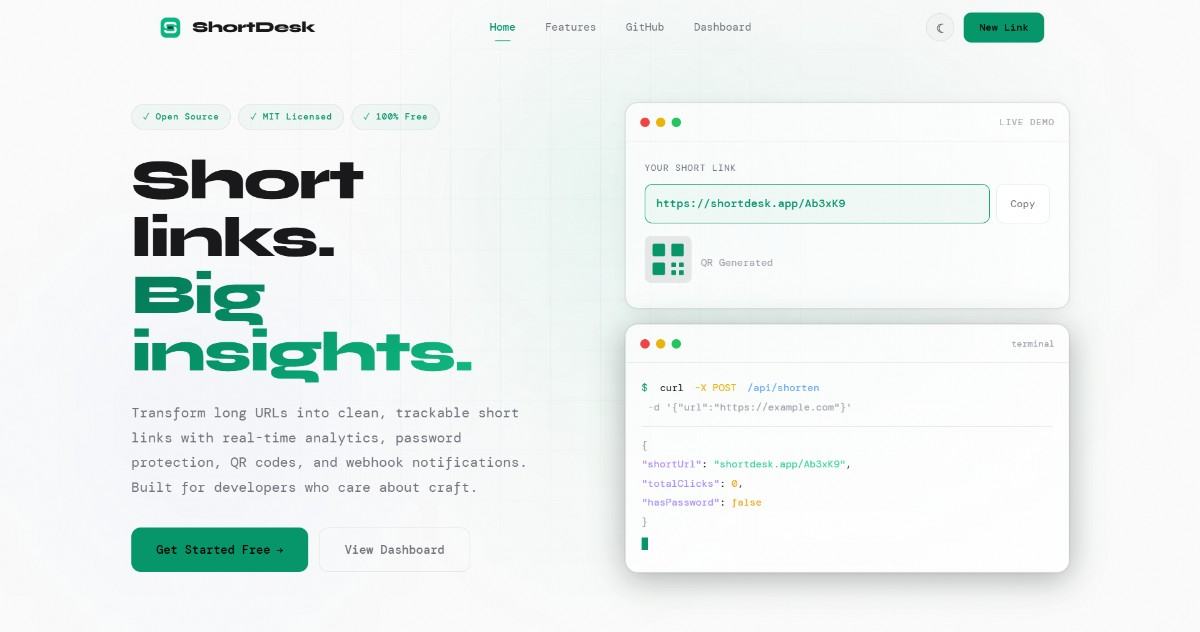
ShortDesk is an open-source URL shortener that turns long, cluttered links into short, clean slugs, each with its own QR code. I built it for developers and everyday users who want a better-looking alternative to generic link shorteners, and it's live on serverless hosting.
The problem
Generic link shorteners do the job, but most of them look dated and hand you a random string you can't remember. I wanted a tool that pairs solid link handling with a modern, visually distinct interface.
How it works
- Link transformation: converts long, cluttered URLs into concise slugs.
- Custom aliases: you can pick your own alias (e.g.
/myproject) instead of a random string. - QR codes: every shortened link gets a scannable QR code generated automatically, which makes mobile sharing easy.
- Smart validation: built-in checks make sure only valid
http://orhttps://URLs are processed.
Architecture
| Layer | Technology | Purpose |
|---|---|---|
| Backend | Node.js & Express | Routing, API logic and URL validation |
| Database | MongoDB Atlas | Cloud-based persistent storage for URLs and analytics |
| Frontend | EJS & CSS3 | Server-side rendering with a Glassmorphism UI |
| Deployment | Vercel | Scalable, serverless hosting |
| Utilities | Nanoid & QRCode.js | Unique ID generation and QR code creation |
I chose this stack for fast development and easy cloud integration.
Design and usability
The interface is what sets ShortDesk apart. Instead of the utilitarian look most link tools have, it uses a Glassmorphic UI with translucent elements and a clean light-mode aesthetic.
Tech stack
Node.js Express MongoDB Atlas EJS CSS3 Nanoid QRCode.js Vercel
Development & distribution
ShortDesk is open source under the MIT License and built to be easy to replicate:
- Local development: detailed instructions are included, and the only setup is standard environment variables (
Mongo URI,Port). - One-click deploy: it supports one-click deployment to Vercel, so other developers can run their own instance.
Case Study
Problem
Generic link shorteners work, but many look dated and only offer random strings as short links. I wanted an open-source shortener that combines solid link handling, custom aliases and QR codes with a modern Glassmorphic interface.
Approach
- Built the backend with Node.js & Express for routing, API logic and URL validation
- Stored URLs and analytics in MongoDB Atlas
- Rendered the UI server-side with EJS & CSS3 using a Glassmorphism design
- Used Nanoid for unique IDs and QRCode.js to generate a QR code for every link
- Added custom aliases (e.g.
/myproject) and validation so onlyhttp://orhttps://URLs are accepted - Deployed on Vercel serverless hosting
Results
- Fully operational and live on Vercel
- Open source under the MIT License
- Ready for others to run locally with only
Mongo URIandPortconfigured, or deploy to Vercel in one click