From Student to Engineer: What My First Software Job Really Taught Me
The tools, acronyms, and hard-won lessons from my first job as a software engineer — Swagger, Bitbucket, Jira, JWT, MySQL, MongoDB, and the unspoken truths nobody teaches you in university.
 Nilay Naha
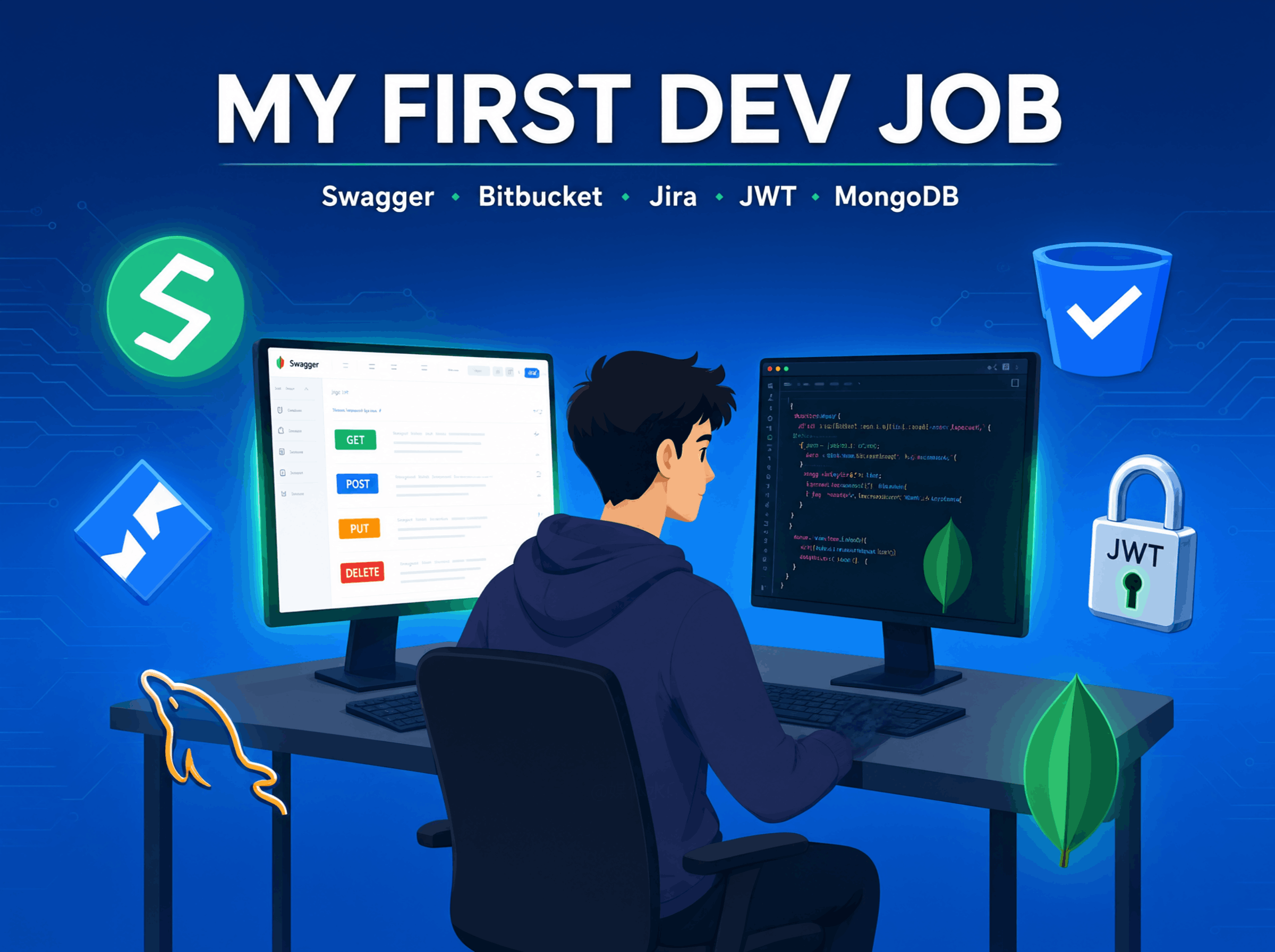
I still remember the nervous excitement of my first day as a junior software engineer. I had the degree, the side projects and a head full of theory — but stepping into a professional team felt like entering a different dimension.
There were tools, acronyms and workflows I had only heard in passing: Swagger, Bitbucket, Jira, JWT, MongoDB. Some I knew by name, but I had never actually used them. This is the story of what I learned, what I faked until I made it, and how those first months turned me from a student into an engineer.
#FirstJob #SoftwareEngineer #APIs MongoDB JWT
"You don't really know a tool until you've broken it in production… or at least in staging."
— My senior dev, on day three
The tools I'd heard of but never touched
At university we used GitHub, simple REST calls and MySQL. The professional world had a much richer vocabulary. Here's what was completely new to me — and what I learned.
I'd heard "API documentation" but never used a spec. Swagger (OpenAPI) became my daily companion for testing endpoints, understanding request/response schemas and even generating client code. It was like a live contract for the backend.
I was a GitHub person. Bitbucket felt similar but integrated with Jira. I learned branching strategies (Gitflow, trunk-based), pull request reviews, and how to handle merge conflicts without panicking.
My first taste of agile. I learned to estimate story points, move tickets across boards, and write meaningful commit messages linked to issues. It taught me that code is only half the job — tracking and communication matter.
JWT and JSON — the language of modern auth
I had used JSON before, but JWT (JSON Web Tokens) was a mystery. I learned how tokens are structured (header, payload, signature), how to decode them, and why they're used for stateless authentication. Debugging a 401 caused by an expired token became a rite of passage.
- JSON everywhere: from request bodies to config files, JSON became my native tongue. I learned to validate schemas and handle nested objects gracefully.
- JWT deep dive: I implemented token refresh logic, understood the difference between signing and encryption, and learned why you never store sensitive data in the payload.
APIs: public, private, and the status codes that haunt you
Before this job, I thought an API was just a URL that returns JSON. I quickly learned the nuances:
- Public APIs: exposed to external consumers, often with rate limiting, API keys and OAuth. I learned to design them with versioning (
/v1/) and clear documentation. - Private APIs: internal only, behind a VPN or service mesh. These were more forgiving but still required careful authentication and logging.
- HTTP status codes: I memorized the important ones —
200201400401403404500— and learned that returning the wrong code can confuse clients and break integrations.
Databases: from MySQL joins to MongoDB documents
I was comfortable with MySQL — SELECT, JOIN, indexes. Then I met MongoDB, and it was a paradigm shift.
| MySQL | MongoDB |
|---|---|
| Relational, tables, rows | Document-oriented, collections, BSON |
| Strict schema, migrations | Flexible schema, but needs discipline |
| JOINs for complex queries | Embedding or referencing documents |
| ACID transactions | Multi-document transactions (since 4.0) |
I learned when to use which: MySQL for transactional, highly structured data; MongoDB for rapid prototyping and hierarchical data. Both taught me the importance of indexing and query optimization.
The unspoken lessons nobody teaches
- Ask early, ask often: I wasted hours on a cryptic error before asking a teammate. Now I ask after 20 minutes of struggle.
- Read the codebase: the best documentation is often the existing code. I learned to navigate large repos and trace execution paths.
- Write for humans: commit messages, PR descriptions and comments should explain why, not just what. My future self thanked me.
- Testing is not optional: I wrote my first unit tests with JUnit and Mockito. They saved me from embarrassing regressions.
- Own your growth: no one will spoon-feed you. I set aside 30 minutes daily to read docs or experiment with a new tool.
Looking back, moving forward
That first job was a bootcamp in real-world engineering, and I made plenty of mistakes. I once pushed a broken build because I forgot to run tests locally. I misconfigured a JWT secret and locked myself out. But each mistake taught me something no tutorial could.
Today, when I open Swagger, create a Bitbucket PR or debug a MongoDB aggregation pipeline, I smile. These tools are no longer scary acronyms — they're part of my craft. And I'm still learning.
"The first job doesn't just teach you how to code. It teaches you how to think, how to ask, and how to grow."
— Me, two years later
Reference links and documentation
Every tool and concept I mentioned has an official home. These are the links I wish I'd had on day one.
| Tool | Type | What you'll find | Link |
|---|---|---|---|
| Swagger / OpenAPI | Spec | The OpenAPI Specification, Swagger tools, and how to design, document and test APIs | swagger.io/docs |
| Bitbucket | Git | Repositories, pull requests, pipelines and Jira integration for agile workflows | bitbucket.org/guides |
| Jira | Agile | Boards, backlogs, sprints, story points and issue tracking | atlassian.com/jira/guides |
| JWT | Auth | The JSON Web Token spec (RFC 7519) and jwt.io intro: header, payload, signature and best practices | jwt.io/introduction |
| JSON | Format | Syntax, data types, and how JSON became the lingua franca of web APIs and config files | json.org |
| HTTP Status Codes | RFC | MDN's reference for 200, 201, 400, 401, 403, 404, 500 and everything in between | MDN HTTP Status |
| REST API Design | Guide | RESTful design principles — versioning, resource naming, HTTP methods and REST's constraints | restfulapi.net |
| MySQL | RDBMS | SELECT and JOIN through indexing, transactions and performance tuning | dev.mysql.com/doc |
| MongoDB | NoSQL | Document modeling, aggregation pipelines, indexing and flexible schemas | mongodb.com/docs |
| Postman | Testing | Sending requests, inspecting responses, writing test scripts and collaborating on APIs | learning.postman.com |
| Git | VCS | Branching, merging, rebasing and the version control behind Bitbucket, GitHub and GitLab | git-scm.com/doc |
Key takeaways
- Swagger, Bitbucket and Jira are learnable fast once you use them daily — the vocabulary is the hardest part.
- Understand JWT structure and expiry; a 401 is often just an expired token.
- Return honest HTTP status codes — never a 200 with an error inside.
- Pick MySQL or MongoDB based on the shape of your data, and index either way.
- Ask for help after 20 minutes, write for humans, test before you push, and own your growth.
Swagger · Bitbucket · Jira · JWT · JSON · REST · MySQL · MongoDB · HTTP — no longer scary acronyms, just part of the craft.